"I Want You to Want to Do the Dishes"
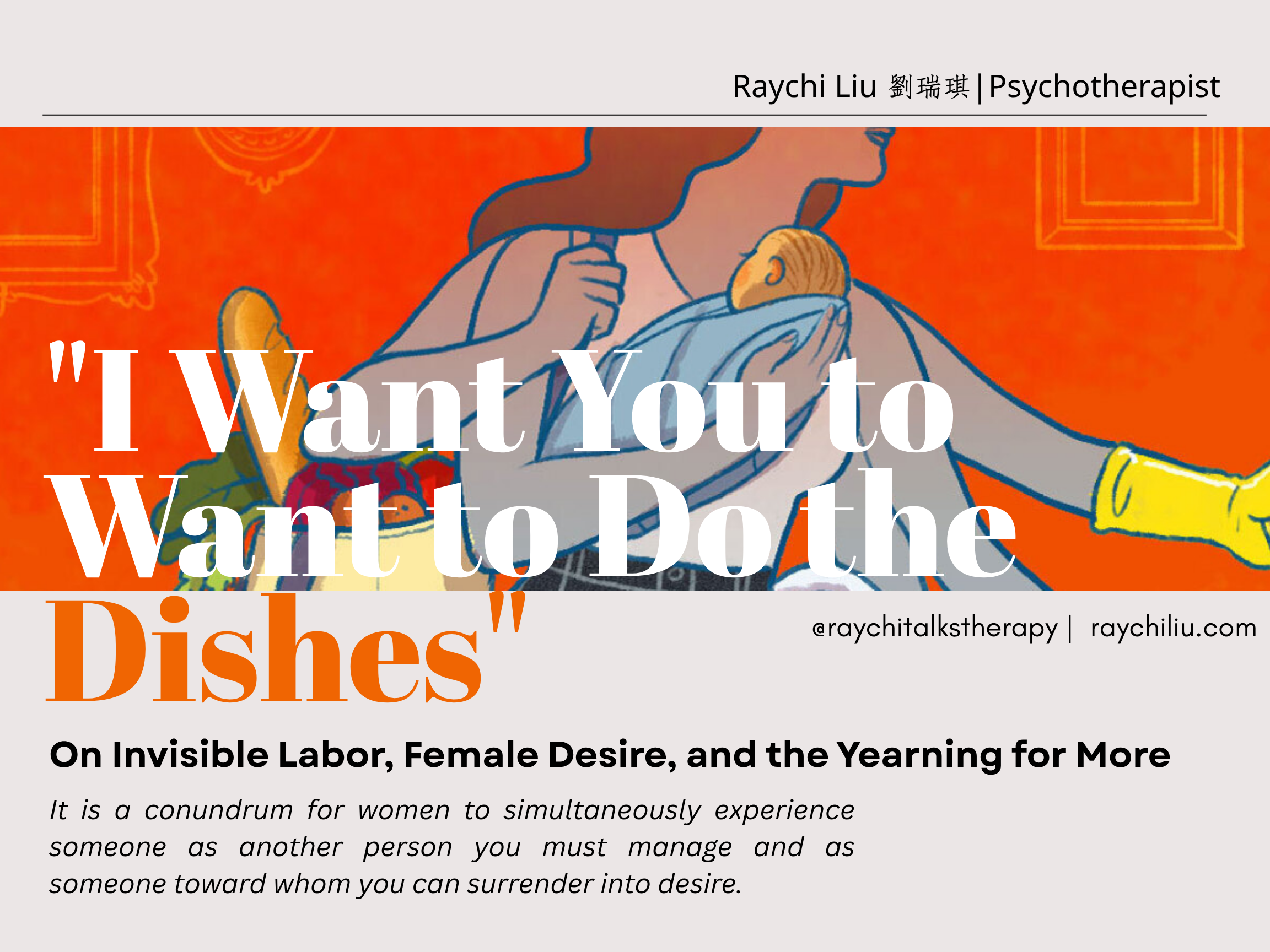
I grew up in a small town in China, surrounded by unhappy women.
While my cousins and I played in the playground, we could usually overhear our mothers and the neighbor women trading complaints about their husbands in low, tired voices. And yet these were the same women who never let go of the family. They did the dishes, the laundry, the school runs. They fought hard to get us into a good school, worked extra shifts to move us to a better neighborhood, and saved carefully for our college fund. They held the whole structure up with their hands while the men in our lives got to enjoy something that looked, from a child’s height, like freedom — advancing in their careers, drinking without consequence, disappearing into hobbies, and sometimes, we would later learn, into affairs, into gambling debts, or into a new car.
As kids, we knew the shape of this without having language for it. Dads and uncles were fun. Mothers and aunts nagged too much, cried too much, and were, in some low hum beneath everything, always unhappy.
It took me twenty years, several failed and instructive relationships, a master's degree in psychology, and hundreds of hours sitting across from female clients to name what I was actually witnessing as a child. There was a wound a yearning there. One that ran quietly through my mother, through my aunts, and — I've had to admit — through me. A wound shared by thousands of women who look nothing alike and have never met each other, and who would still recognize themselves in each other's exhaustion immediately: Who takes care of the woman who takes care of the whole family?
“I want you to want to do the dishes”

Here is the famous scene in the movie The Break-Up. Brooke is frustrated with Gary because she wants him to help with the dishes after she has already handled dinner and much of the household work. Gary essentially responds: Fine. Just tell me what you want me to do. And Brooke’s frustration culminates in the now-famous line:
“I want you to want to do the dishes.”
Taken literally, Gary's confusion makes sense: Why would anyone want to do dishes? But it's never about doing the dishes. She's saying: “I want you to notice what needs doing without making me responsible for noticing it for you”. She wants evidence of attunement. She wants a shared life to feel like a shared responsibility. But in that moment, the only concrete language available to her is: the dishes.
This scene became famous because it stirred something so common in so many women yet so hard to name. It reflects something many of us absorbed long before we entered our first relationship. Girls are often trained early to maintain an internal model of us: to notice moods, anticipate needs, smooth over conflicts, keep track of what needs doing, and hold the emotional map of a household. Boys have historically received a different message: provide financially. And sometimes, financial provision is presented as evidence that you have fulfilled all your parts.
Invisible Labor
In Invisible Women, Caroline Criado described the sociological frameworks that commonly break down the pressures on women's time and unseen workloads into three main categories of labor:
Practical labor is the most visible one: cooking, cleaning, childcare, groceries, appointments. It’s countable. You can see whether it got done.
Mental load is less visible: remembering that a birthday is coming, that the pet needs a vet appointment, that the milk is almost gone, that nobody has made plans for the weekend. This isn’t the same as completing tasks but holding the map of all the tasks in your head at once, continuously, so that nothing falls through.
Emotional and relational labor is the least visible of all: noticing that your partner has gone quiet, remembering what’s been weighing on them, being the one to start the hard conversation, repairing the rupture afterward, keeping the extended family and friendships alive, sensing what’s coming before it arrives.
The last two forms of labor share a strange feature. They are invisible, assumed to be there right up until the moment they stop happening. Nobody notices the mental load being carried until the birthday is forgotten. Nobody notices the emotional labor until the friendships have quietly faded, the resentments have gone unaddressed, or the distance between two people has become the room they’re both standing in.
Society tends to value what we can see, count, and price. But much of the work required to keep households, families, and relationships functioning resists easy measurement—and historically, women have performed a disproportionate share of that work.
Since the second-wave feminism movement, women entered the paid workforce in enormous numbers. Economic independence gave many women choices that previous generations simply did not have. Our Persian-oriented education system and capitalism-driven society have gotten remarkably good at preparing girls for the masculine-coded, capitalist world — ambition, competition, self-advocacy, achievement. But there's no equivalent curriculum preparing boys for the relational world: how to hold a household, tend a friendship, repair a rupture, notice what someone else needs before being asked. For boys, vulnerability is still shamed, emotions other than anger are still labelled as weak, emotion socialization is less practiced with sons. We expanded what girls are trained to do yet never asked boys to expand what they're trained to be.
The Madonna–Whore Split
Our culture likes to offer women two available archetypes: the Madonna and the “whore”. The Madonna as pure, nurturing, respectable, wife-and-mother material, and the "whore" as sexual, desiring, exciting, yet less worthy of respect. In the classic Madonna–Whore split, a woman can occupy two separate positions in a man's psychological world: the one who takes care of him, and the one who satisfies him sexually. What's missing from both positions is her as a subject in her own right, someone whose desires, boundaries, and sexuality actually belong to her. She's expected to perform both roles at once, while her own interiority quietly disappears from the equation.
And in long-term heterosexual relationships, women can find themselves pulled heavily toward the first role: mothering, soothing, accommodating, nurturing. Meanwhile, the erotic self can become increasingly difficult to access.
Not because women somehow cease to be sexual once they enter long-term relationships, but more because eroticism has difficulty flourishing when one person becomes responsible for managing the life of us. It is a conundrum to simultaneously experience someone as another person you must manage and as someone toward whom you can surrender into desire.
It’s not a coincidence, then, that so many women in long relationships describe losing interest in sex within a particular relationship, or sometimes experiencing sex itself as another obligation, and then being surprised by the return of desire after that relationship ends. They found that the desire never left; it went underground because the conditions that allowed desire to breathe were gone.



Woman is asked to be mother-like in her caregiving and lover-like in her availability. What gets forgotten—in relationships, in culture, and sometimes inside women ourselves—is woman as person, not as function.
What am I actually experiencing? What do I want, for myself, apart from what's wanted of me? Raised inside patriarchal gazes, conditioned into expected invisible labor before we could even name it, we are something like a bird that never learned to fly, still yearning toward a sky yet have no means to access it. What does it feel like, underneath all of it, to simply be me?
Yearning for….More?
Twenty years ago, Elizabeth Gilbert’s Eat, Pray, Love became an international sensation. Gilbert describes her being deeply unhappy despite having many conventional markers of success: marriage, a home, a career, and financial stability. She recounts finding herself crying on the bathroom floor at night, recognizing that something was fundamentally wrong.
And she left.
The book gave language to a certain kind of adult reinvention, especially for women beginning to question marriage and every inherited idea of what a “good life” should look like. Its central proposition was radical in its simplicity: you are allowed to disappoint who you were supposed to become, in order to find out who you actually are.
I remember watching the film version with my very Chinese mother. She called Elizabeth “irresponsible.” She called the story “unrealistic.”
Almost twenty years later, reflecting on that evening, I can see my mother’s shadow in her own judgment. Perhaps her reaction to Gilbert’s choice was never really about Gilbert. Underneath it was a numbed, unspoken yearning of her own — for freedom, for joy, for sensuality, for the courage to say no to a patriarchal script that asks her to trade her aliveness for the sake of keeping the whole family float. To finally walk away.
What sounded like disapproval was, I guess, fear to see the door she never let herself imagine walking through.
Year after year, I saw my mother, and many women in my life, and now my female friends and female clients, saying the same thing in different words, again and again. Yet nothing changed — not because the pain wasn't real, but because the culture we live in has never quite been any woman's home. We are, in Simone de Beauvoir's phrase, the second sex. Beyond the cage, we don't have a model for what it means to simply be female and be ourselves.
But I am still writing. Because I refuse to believe that aliveness is simply a mood that we women as a collectively whole are somehow failing to access.
I am writing because I believe finding our way back to joy and sensuality does not require abandoning everything and buying a one way ticket to Italy; I believe it can begin much closer to home.
I don’t know exactly how though. But it probably begins with learning that being loved and being needed are not the same thing. And it begins with having the courage to expect more from our partners so that our brothers have a chance to step up, and allowing ourselves to believe that wanting to be cared for as deeply as we care for others is not asking too much.
And perhaps most importantly, it begins with recovering the right to ask a question that sounds extraordinarily simple but that generations of women have struggled to answer:
What do I want?
My mother never got the words to describe her pain. I’m trying, in writing this, to find them for her — and, in the process, for myself.